
GDC Releases After Wilkes Custody
The Georgia Department of Corrections is a statewide prison system, not a detention facility located in Wilkes County for this project. It becomes relevant after a Wilkes court imposes a state prison sentence and GDC accepts the person. The Wilkes County Jail record may show a transfer to state custody. That line proves only that the county hold ended and identifies the next agency when the destination is releasable. It does not prove that the person returned to the community.
Once GDC controls the sentence, the state offender record is the main public source for facility location, offense information, status, and a release date when shown. A later release can mean max-out, parole, discharge, or another legally defined movement. A parole release may lead to supervision by the Georgia Department of Community Supervision. A max-out generally means the judge's sentence has been completely served. Each event is different from bond, time served, or a court-ordered release from Wilkes County Jail.
| Event | Record source | What it establishes |
|---|---|---|
| Wilkes jail transfer to GDC | Sheriff booking/release record | End of the county hold and transfer destination |
| State prison status | GDC Find an Offender | State custody, facility, sentence, and release fields shown |
| Parole decision | State Board of Pardons and Paroles | Review or parole status |
| Community supervision | DCS | Parole or adult felony probation supervision |
Confirm a GDC Prison Release
The official GDC Find an Offender search is the correct public lookup for a Wilkes County defendant who entered Georgia state prison. Search with as much identifying information as possible. A common name can return several people, so compare GDC ID, physical description, offenses, and any case information before relying on the result. The service warns that an offender photograph displays automatically when available.
- First verify through the Wilkes jail or court that the person actually entered GDC custody.
- Open Find an Offender, review its terms, and search by name, GDC ID, case number, or available description fields.
- Open the matching record and read the current status, location, offenses, sentence information, and release date fields.
- If the person is still imprisoned, use the Board's TPM tool only for parole-review context. A TPM is not proof of release.
- If the record indicates parole or discharge, compare it with the parolee database and DCS supervision route when applicable.
A missing result does not establish release. Spelling, aliases, delayed data, or the absence of a state sentence may explain it. Return to the Wilkes court disposition and county transfer record to determine whether GDC was ever the controlling system. The broader Wilkes County released inmate search separates county, state, federal, and immigration custody paths.
Read GDC Release Record Fields
GDC records use state-prison terms that do not map neatly onto local jail events. Maximum Release Date, often called MRD or max-out, is the date the judge's sentence will be fully served. A Tentative Parole Month, or TPM, is a Board review target. The Board stresses that it is not a final parole decision. Performance Incentive Credit, or PIC, is a GDC program for eligible state prisoners and can affect certain state timelines. It is not a Wilkes County Jail policy.
- Current status
- Whether the record describes confinement, release, discharge, or another published state status.
- Facility location
- The GDC institution tied to the person while in state custody.
- Maximum Release Date
- The sentence-completion date as calculated under the state record, when applicable.
- Tentative Parole Month
- A possible parole-review month, not a guaranteed release date.
- Discharge
- The formal end of custody or sentence status shown by the responsible state system.
Georgia rule 125-2-4-.04 supplies definitions for MRD and TPM and notes special cases such as life or death sentences. Georgia's Performance Incentive Credit material says eligible offenders can earn points that may reduce a TPM or MRD. O.C.G.A. Section 17-10-6.1 places strict limits on parole and sentence-reducing measures for certain serious violent felony sentences. There is no sound universal percentage that predicts every Georgia state release.
Correct Wilkes GDC Release Data
Send a correction question to the agency that created the disputed field. The Wilkes County Sheriff's Office controls its booking, release, and transfer entry. The sentencing court controls the judgment, sentence, jail credit, and later court orders. GDC controls its prison location and sentence-computation fields. The Parole Board controls parole review and decisions. DCS controls day-to-day supervision records after release.
This source split is especially useful in Wilkes County because no public county recent-release table was found. If a jail record says transfer to GDC but the state search has no match, gather the person's full name, birth information, booking number, case number, and approximate transfer date. Ask the sheriff for the receiving agency and the court for the state sentence. Then ask GDC about the exact state field. Avoid asking one office to alter another agency's record.
Note: Keep the county transfer record and state discharge record together because they document two separate stages of custody.
GDC Records and Contact Route
GDC's public offender information should be checked before seeking individual clarification. The GDC offender-info page routes users to Find an Offender and explains state correctional resources. The state office address documented in the research is 300 Patrol Road, Forsyth, GA 31029. The offender search and location pages list 404-656-4661 for inmate concerns and questions. Confirm the correct unit before sending a record request because the Wilkes sheriff, GDC, and Parole Board hold different records.
Georgia Department of Corrections300 Patrol Road
Forsyth, GA 31029
404-656-4661
State offender questions
The official GDC offender-information source shown below is a suitable starting point for the state-prison path. It should not be used as a county recent-release roster.
Open the GDC offender-information source.
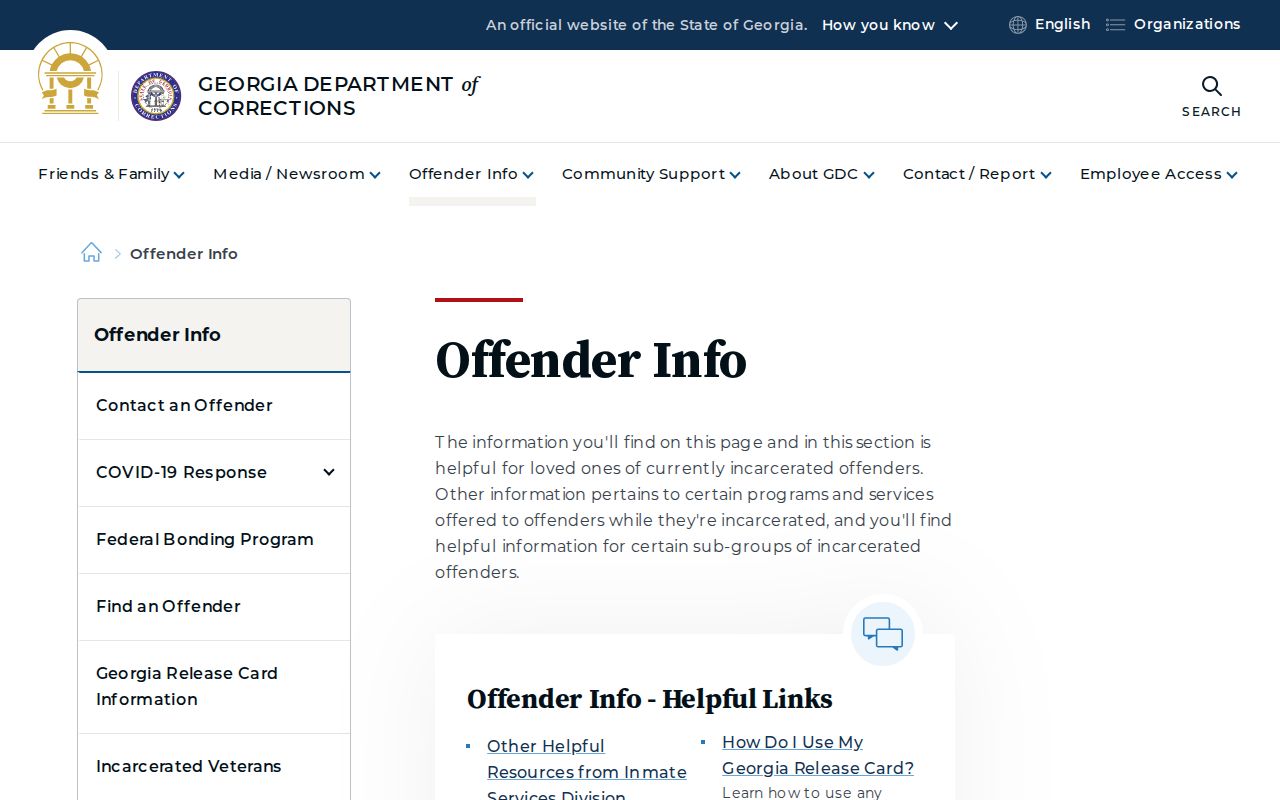
The page directs a Wilkes County search toward the statewide correctional record and its related state programs.
GDC Parole and DCS Handoff
GDC confinement, parole decision-making, and community supervision belong to separate state functions. The State Board of Pardons and Paroles decides parole and provides the Inmate TPM Lookup for people still in prison. It also provides a public parolee database for people already on parole. Since July 2015, DCS has handled supervision of Georgia parolees as well as adult felony probation.
A detainer can alter where a person goes. The Board may conditionally transfer a person to another authority rather than release that person directly into the community. Therefore, a GDC status change or county release entry should be read with the destination and supervision terms. For a Wilkes resident placed under parole supervision, the DCS directory routes Wilkes County to the Thomson Field Office. That office does not calculate GDC's MRD and does not prove the original county release.
The sequence is best read as: Wilkes custody, if any, then state intake, GDC confinement, Board action when parole applies, release or discharge, and DCS supervision when ordered. A later violation can lead to arrest or revocation, so an older released status may not describe present custody.
About Georgia State Prison Custody
GDC holds state-sentenced offenders across Georgia. It is not the ordinary lookup for a person released from Wilkes County Jail on bond, time served, dismissal, or a short local sentence. Those local events remain with the sheriff and court. GDC becomes the right system only when a state correctional sentence or state custody record exists.
The distinction also affects photographs and dates. A GDC photograph is a state corrections image, not necessarily the Wilkes booking photo. A GDC release date relates to state prison custody, not necessarily the date the person left the county jail for intake. Likewise, a tentative parole month is not a scheduled county release time. Match every field to its agency and custody stage before drawing a conclusion.
Parole eligibility is not parole approval. Offense-specific law and sentence terms can limit release. Report only the status and date an official source shows. A public TPM entry cannot establish the day a person left prison, the destination, or whether DCS supervision began. Those facts require final Board, GDC, and DCS records. If sources conflict, ask the agency responsible for the changed field.