
Wilkes Three-Day Feed Status
No exact 72-hour feed URL was found on the official Wilkes jail page or the sheriff material captured for this project. The county does not publish a visible three-day release table there. It also gives no public update cadence, retention statement, release-photo column, or defined list of displayed fields. That finding is the starting point, not a gap to fill with an unofficial list.
A three-day search must therefore reconstruct the record trail. Contact the Wilkes County Jail / Wilkes County Detention Center for each possible release date. Then use the court, VINE, GDC, or receiving agency that fits the answer. The broader range is most useful when a family member knows the person may have left custody but does not know the exact date.
Trace Wilkes Three-Day Releases
Gather identifiers before contacting an office. Use the person's full legal name, date of birth, approximate booking date, and possible case number. These details help staff distinguish one booking from another and connect a jail event to its court file. Ask whether the person was released or transferred. Those words are not interchangeable.
- Set a clear three-day range, including the start and end dates of the suspected release period.
- Call the Wilkes County Jail at 706-678-2224 and ask whether the person is held, released, or transferred.
- Request the recorded release date and time, release type, booking number, case number, and destination.
- Review Georgia VINE for a custody-status change, while treating the alert as notice rather than the official record.
- Check the Wilkes court record when bond, warrant recall, dismissal, sentence credit, or another order caused the release.
- Follow GDC, BOP, USMS, ICE, or another county if the jail reports an agency transfer.
The Wilkes 24-hour release workflow is a tighter same-day check when the likely date is known. The three-day approach is better for an uncertain date and for connecting several office records across adjacent days.
Wilkes Three-Day Record Fields
The sheriff does not expose these fields in a captured public 72-hour table. They are the fields a requester should name when seeking the underlying booking and release record. Asking for the release event tied to one person and one date range is clearer than seeking a broad list of every person processed.
| Field to request | Why it matters across three days |
|---|---|
| Name and booking number | Connects the result to the right person and custody episode. |
| Booking date | Separates the release from an earlier or later arrest. |
| Release date and time | Places the event inside or outside the selected 72-hour span. |
| Release type | Shows bond, time served, sentence completion, court order, transfer, or another recorded outcome. |
| Charges and bond | Links the custody event to the charge and any bond path, if releasable. |
| Court case number | Points to the order or disposition that may explain the jail action. |
| Transfer destination | Identifies a new custodian when the person did not leave custody for the community. |
The jail release record documents the administrative event. A court disposition explains the legal change behind some releases. If the person was sent to GDC, the county entry may end with a transfer while the state offender record begins a new custody phase.
Build the Wilkes Date Range
A 72-hour range is not always the same as “the past three calendar dates.” Define it when making a request. If the suspected event was late Friday, for example, give the exact Friday-through-Monday dates that matter. Do not assume an agency uses the same rolling cutoff a private search tool might use. Wilkes publishes no captured cadence for such a feed.
Processing time can also differ from the time of a court act. The court may enter a bond or sentence order before jail staff receive it and complete the release steps. A transfer entry can post when the receiving agency assumes custody. Use the recorded jail release time for the county event, then compare it with the court file or receiving record.
Note: State the actual start and end dates when asking Wilkes officials to check a three-day release period.
Wilkes Roster Gaps Need Verification
No official online current roster or recent-release window was found in the captured Wilkes sheriff pages. This is the county's most important data quirk. A person cannot safely be described as having “dropped off the roster” when there may be no public roster to compare. Search results from other sources can also lag or cover a different custody system.
Use the agency that created each fact. The jail owns the Wilkes booking and release event. The court owns its bond, sentence, dismissal, warrant, and disposition records. GDC owns state-prison custody and discharge information. BOP handles federal prison records, while ICE's locator is for immigration custody. VINE provides status-change notice from participating feeds but does not replace an official release record.
- County release
- The Wilkes jail hold ended by release or agency handoff.
- State transfer
- The county hold ended while GDC custody began.
- Court disposition
- The order or case result that can explain why the legal hold changed.
- VINE notice
- A custody alert that should be checked against the originating agency record.
Request Wilkes Three-Day Records
Send a narrow open-records request to the Wilkes County Sheriff's Office at 225 Andrew Drive, Washington, GA 30673. The listed office phone is 706-678-2224, and the fax is 706-678-1300. Name the person and the three-day range. Add date of birth, booking date, arresting agency, and court case number when known.
Ask for the releasable booking and release record, including the release date and time, release type, booking number, charges at booking, bond information, court case, and transfer destination. The Georgia Open Records Act allows fees, redaction, and time for search and retrieval. A precise request reduces the work needed to identify the record.
The Georgia open-records overview shows the statewide access context for agency requests:
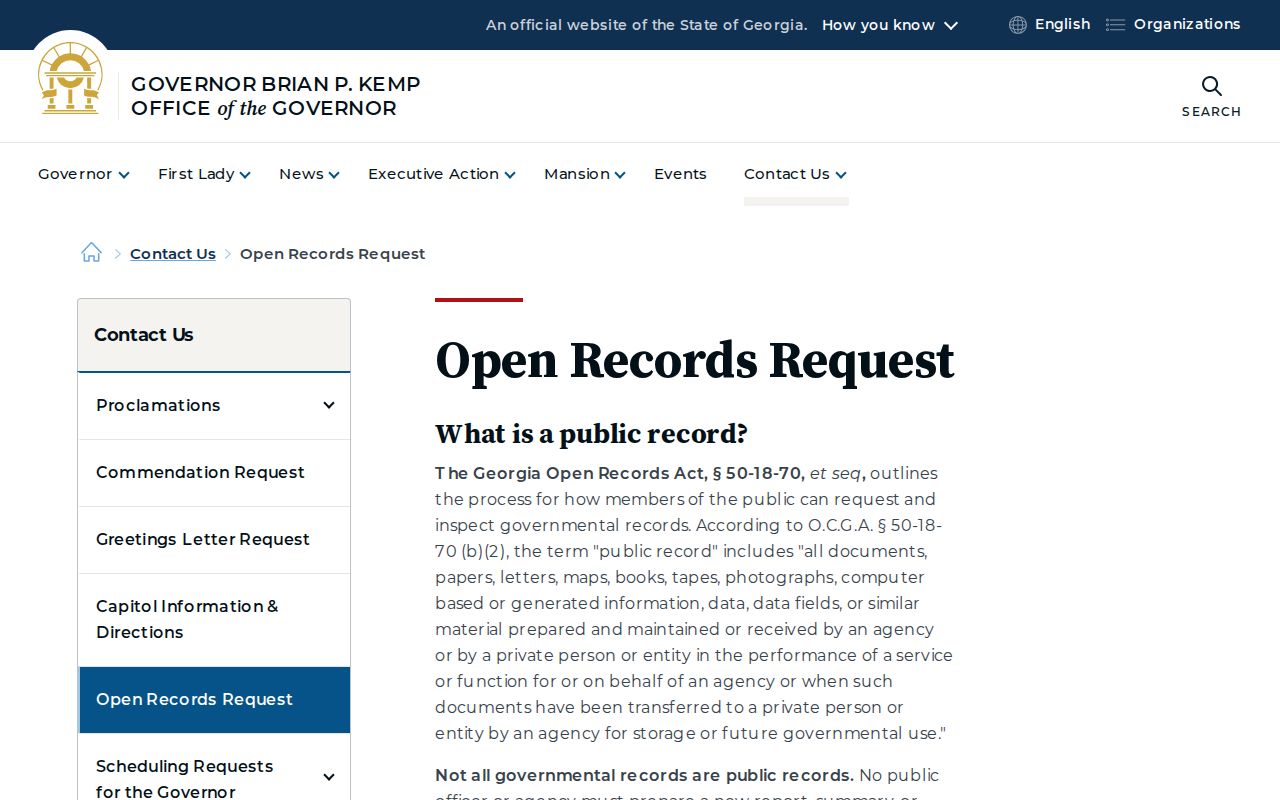
The image explains the state request setting, while Wilkes County Sheriff records remain the source for the local jail release event.
Match Wilkes Releases to Courts
Use the court record when the jail names a legal reason rather than a simple transfer. The Wilkes County Clerk of Superior Court is the local custodian for Superior Court records. Its office can supply the disposition, sentence, bond order, revocation order, or sentence-credit record for matters in that court. Magistrate Court can matter at the warrant, warrant-application, first-appearance, bond, or county-ordinance stage.
A dismissal, nolle prosequi, plea, conviction, bond order, probation sentence, warrant recall, or time-served ruling may be the event behind the jail's release entry. “Nolle prosequi” means the prosecution chose not to proceed with a charge at that point. The jail can say what happened to custody. The court file can show why the legal hold changed.
For a state sentence, do not ask Wilkes jail staff to calculate the final prison discharge. Search the Georgia Department of Corrections offender database and use state parole or supervision tools if they apply.
Separate Wilkes Release Paths
The result must identify where the person went. A county release to the community differs from a handoff to another custodian. This distinction matters even when both events end the Wilkes booking record within the same 72-hour span.
| Wilkes answer | Next source | Meaning |
|---|---|---|
| Released locally | Jail record and court file | The county hold ended; supervision may still follow. |
| Transferred to GDC | GDC offender search | County custody ended, but state prison custody began. |
| Sent to another county | Receiving jail | Another local agency now controls current status. |
| Federal pickup | BOP, USMS, or federal court | A federal agency took custody or arranged detention. |
| Immigration handoff | ICE locator and agency contact | Immigration custody may continue after the county release entry. |
A person may also be released under parole or felony probation supervision. That means the person is outside jail or prison but must follow supervision terms. DCS serves the supervision role; it does not replace the jail record that proves when Wilkes custody ended.
Confirm Wilkes Three-Day Results
Do not turn a missing name into a release finding. Check spelling, aliases, date of birth, the selected dates, and the custody system searched. VINE may show a status change, while a current-custody tool may stop showing someone after release. GDC can retain a state offender record with release information after prison custody ends. Each result has a different scope.
For the strongest proof, obtain the Wilkes jail release record and pair it with the source that explains the next step. That may be the court disposition, GDC record, another jail's booking, or a federal or ICE custody record. The three-day window organizes the inquiry; it does not replace those official records.